Quick answer: how is AI changing customer experience?
AI is changing customer experience (CX) by moving it from reactive and one-size-fits-all to proactive, personalized, and instant. Customers now expect 24/7 conversational support, recommendations tailored to their context, and answers delivered directly by AI assistants and search engines, often before they ever visit a brand’s website. Brands that win in the AI era combine automation with human empathy, keep their data clean and trustworthy, and publish content that AI systems can find, understand, and cite.
Key takeaways
- Customers expect instant, personalized, always-on service as the baseline, not a bonus.
- AI assistants and answer engines are becoming a new “front door” to your brand.
- Personalization has shifted from segments to individuals, in real time.
- Trust, transparency, and easy human escalation matter more as automation grows.
- Structured, expert, answer-first content is now essential for visibility in both search engines and AI answers.
What is customer experience in the AI era?
Customer experience in the AI era is the sum of every interaction a customer has with a brand, shaped or delivered by artificial intelligence: chatbots and voice agents, personalized recommendations, predictive support, AI-assisted sales, and AI-generated answers that mention (or leave out) your brand.
The key difference from traditional CX is who mediates the journey. Previously, customers navigated your website, called your support line, or browsed a catalog. Today, an AI model often sits in the middle: summarizing options, comparing products, and recommending a shortlist on the customer’s behalf.
Shift 1: From reactive support to proactive service
Traditional CX waited for customers to report a problem. AI-era CX predicts and prevents it.
Predictive models can flag a likely delivery delay, a failing subscription payment, or a product usage pattern that signals confusion, then trigger an outreach before the customer complains. The result is fewer tickets, higher satisfaction, and a brand that feels attentive rather than defensive.
What to do: Identify your top five predictable friction points (billing, shipping, onboarding, renewals, outages) and set up AI-driven alerts and automated resolutions for each.
Shift 2: From business hours to always-on, conversational help
Customers no longer accept “we’ll reply within 48 hours.” Modern AI agents can resolve a large share of routine questions instantly, in natural language, across chat, email, voice, and messaging apps.
The bar has also moved on quality. Customers now compare your assistant not with your old FAQ page, but with the best AI tools they use every day.
What to do: Deploy AI for high-volume, low-complexity requests first (order status, returns, account changes). Measure resolution rate, not just deflection rate, so you know customers are actually getting helped.
Shift 3: From segments to true one-to-one personalization
Old-school personalization meant grouping customers into broad segments. AI enables personalization at the individual level and in the moment: tailoring product suggestions, content, pricing offers, and even tone of voice to each person’s behavior and context.
Done well, it feels like a helpful concierge. Done poorly, it feels invasive. The difference is usually transparency and value exchange: customers accept personalization when they understand what data is used and clearly benefit from it.
What to do: Start with first-party data customers knowingly share, explain how it improves their experience, and give them simple controls to adjust it.
Shift 4: From search results to AI answers
This is the biggest structural change for marketers. Customers increasingly ask questions to AI assistants and see AI-generated summaries in search results, rather than clicking through ten blue links.
This gave rise to Answer Engine Optimization (AEO): the practice of structuring content so AI systems and search engines can extract it, trust it, and cite it as the answer. It works alongside traditional SEO rather than replacing it.
What to do: Treat every important page as a potential answer source. Lead with a clear, concise answer; use question-based headings; add FAQs; and demonstrate real expertise and authorship.
Shift 5: From channels to connected journeys
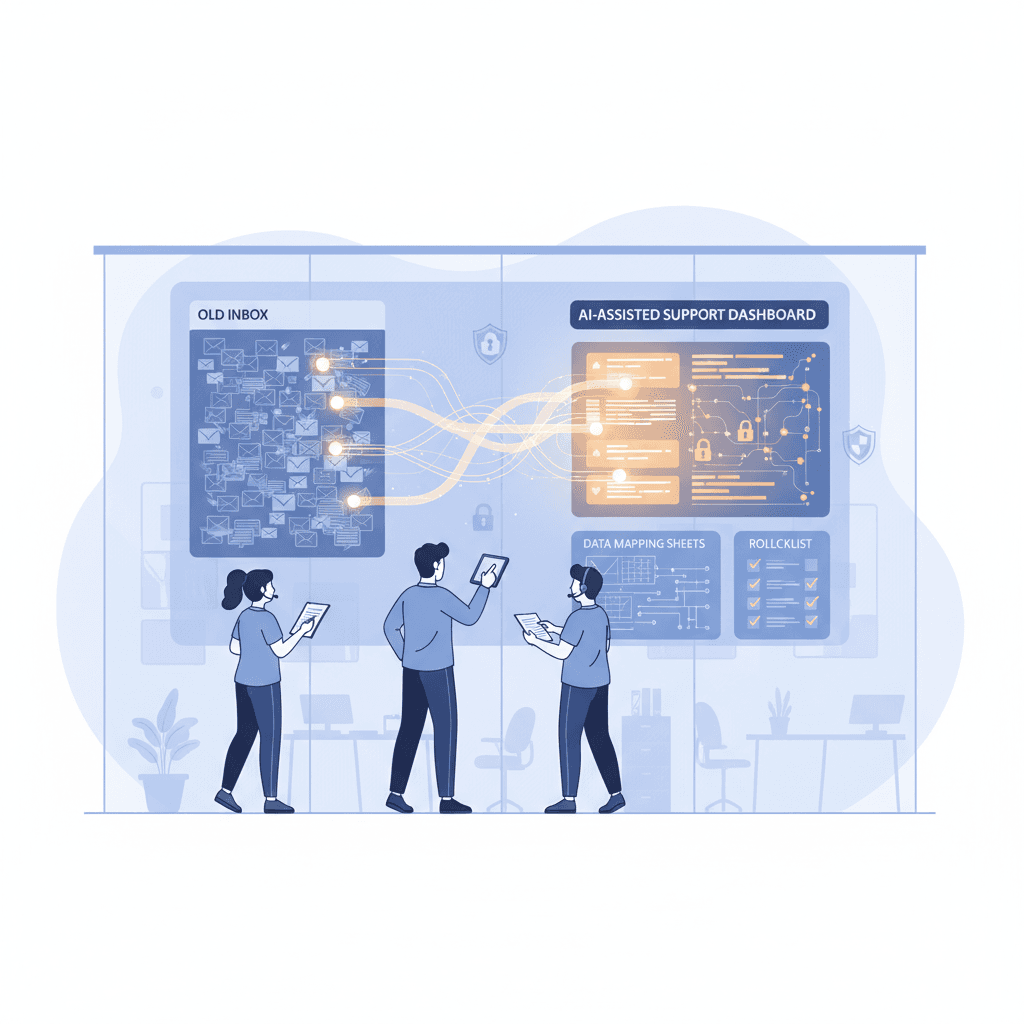
Customers don’t think in channels. They might ask an AI assistant a question, check your app, chat with support, and finish a purchase in-store. AI makes it possible to stitch these moments into one continuous experience, carrying context forward so customers never have to repeat themselves.
The brands that struggle are those with disconnected systems, where the chatbot knows nothing about the customer’s last support call.
What to do: Unify customer data and conversation history across channels, and give both AI agents and human reps access to the same context.
Shift 6: From automation-first to trust-first
As AI handles more interactions, trust becomes the differentiator. Customers want to know when they’re talking to AI, how their data is used, and how to reach a person when it matters.
Three principles consistently separate good AI experiences from frustrating ones:
- Transparency: Disclose AI use clearly.
- Accuracy: Ground answers in verified, up-to-date company information.
- Escalation: Offer a fast, frictionless handoff to a human, especially for emotional, high-value, or complex situations.
What to do: Audit your AI touchpoints for clear disclosure, accuracy checks, and a visible “talk to a person” path.
Shift 7: From support agents to AI-augmented teams
AI isn’t only customer-facing. Behind the scenes, it summarizes conversations, suggests replies, surfaces knowledge articles, and analyzes sentiment, freeing human agents to focus on empathy, judgment, and complex problem-solving.
The role of the CX professional is evolving from answering queues to designing and supervising the system: curating knowledge, reviewing AI performance, and handling the moments that define loyalty.
What to do: Invest in training your team to work with AI, and update metrics to reward quality outcomes, not just speed.
How can businesses prepare for AI-driven customer experience?
A practical roadmap:
- Map your customer journey and mark where friction, delays, and repeated questions occur.
- Fix your data foundation. AI is only as good as the information it can access. Consolidate and clean customer and product data.
- Start small with clear use cases, such as order status, FAQs, or agent-assist, and expand once you see results.
- Build your knowledge base for humans and machines. Clear, structured, current content powers both your AI agents and external answer engines.
- Set guardrails. Define what AI can and cannot do, how it escalates, and how you handle privacy and compliance.
- Measure what matters: resolution rate, customer satisfaction (CSAT), effort score, retention, and revenue impact.
- Optimize for AEO and SEO so your brand appears in both search results and AI-generated answers.
How do you optimize content for AEO and SEO?
If you want AI assistants and search engines to surface your brand, apply these practices:
- Answer first. Put a 40–60 word direct answer at the top of each page or section.
- Use question-based headings that mirror how people actually ask (“What is…”, “How do I…”, “Why does…”).
- Add an FAQ section with concise, self-contained answers, and mark it up with FAQ schema.
- Show expertise and authorship. Include author bios, credentials, sources, and update dates.
- Use structured data (Article, FAQPage, Organization, HowTo) so machines can interpret your content.
- Keep paragraphs short and scannable, with lists and tables where they clarify.
- Strengthen technical SEO: fast load times, mobile-friendly design, clean URLs, internal links, and descriptive alt text.
- Build topical authority by covering related subtopics in a connected content cluster.
Frequently asked questions
What is AI customer experience?
AI customer experience is the use of artificial intelligence, such as chatbots, voice agents, recommendation engines, and predictive analytics, to deliver faster, more personalized, and more proactive interactions across the customer journey.
How does AI improve customer service?
AI improves customer service by providing instant, 24/7 responses, resolving routine requests automatically, predicting issues before they escalate, and helping human agents with summaries, suggested replies, and relevant knowledge.
Will AI replace human customer service agents?
Not entirely. AI is best at high-volume, repetitive tasks, while humans remain essential for empathy, complex problem-solving, and sensitive situations. Most successful brands use a hybrid model where AI and people complement each other.
What is the difference between SEO and AEO?
SEO (Search Engine Optimization) focuses on ranking web pages in search results. AEO (Answer Engine Optimization) focuses on making content easy for AI assistants and answer engines to extract, trust, and cite as a direct answer. The two overlap heavily and work best together.
What are the risks of AI in customer experience?
Common risks include inaccurate or outdated answers, privacy and data-security concerns, over-personalization that feels intrusive, and a lack of human escalation. Clear governance, transparency, and quality monitoring reduce these risks.
How do I measure the success of AI in customer experience?
Track resolution rate, first-contact resolution, CSAT, customer effort score, average handling time, retention, and conversion. Review conversation quality regularly, not just volume.
Conclusion
The AI era isn’t just adding new tools to customer experience; it’s changing how customers discover, evaluate, and stay loyal to brands. The winners will be those who pair the speed and scale of AI with genuine human care, keep trust at the center, and make their expertise easy for both people and machines to find.
Start with one high-impact use case, measure the results, and build from there.