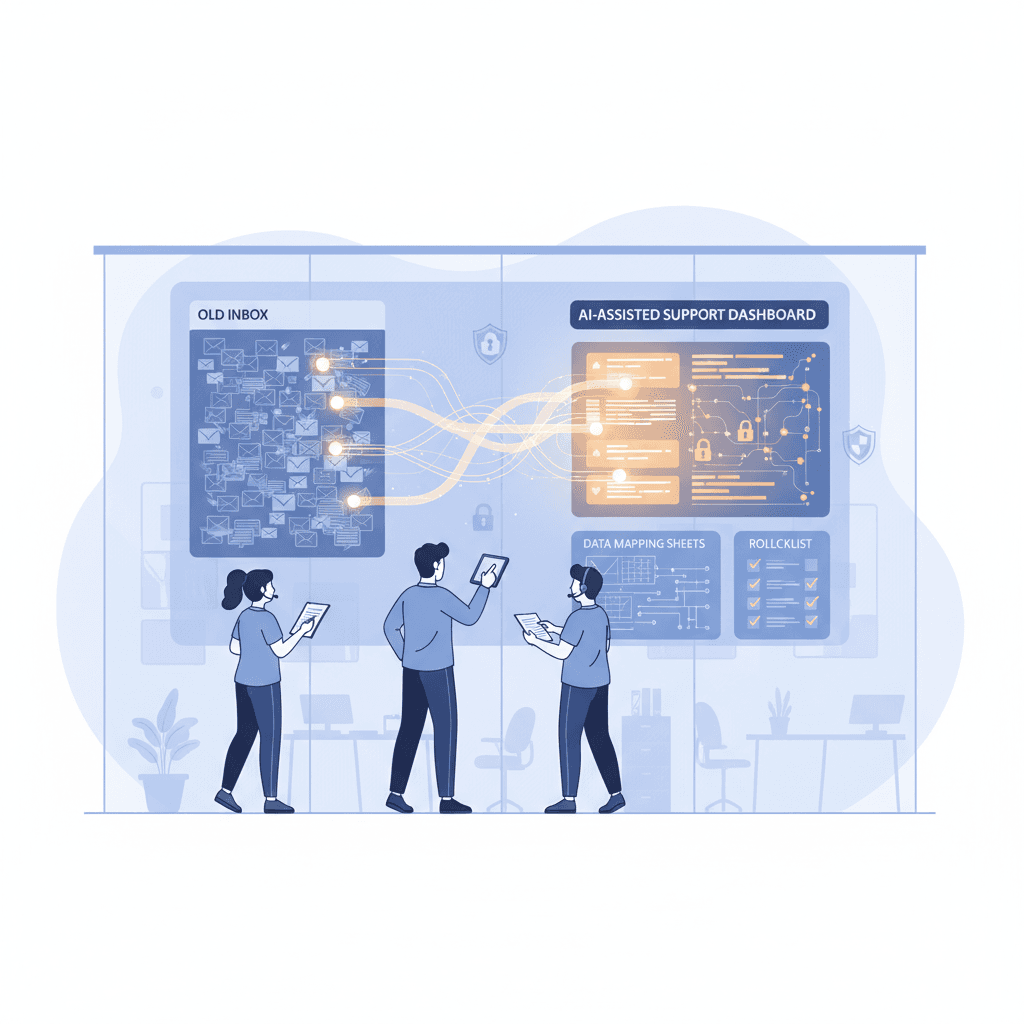
Launching an AI support agent is not primarily a chatbot setup project. It is a content-quality project. When support documentation is outdated, contradictory, overly broad, or missing key exceptions, an AI can retrieve the wrong material or produce an answer that sounds confident but does not help the customer.
For teams adopting AI helpdesk support, the most valuable work often happens before the agent is customer-facing: identifying trusted sources, rewriting unclear articles, defining escalation rules, and testing real customer questions. This guide provides a practical readiness process for building a dependable foundation.
Why knowledge base readiness matters for AI customer support
Traditional help centers can survive with some clutter. A customer might search several articles, use navigation menus, or ask an agent for clarification. An AI support agent must interpret the question, retrieve relevant information, and frame a response in one conversation. That makes inconsistencies and gaps more consequential.
For example, imagine a customer asks whether they can cancel a plan. If one article describes an old policy, another describes a current exception, and a third internal document includes an approval workflow, the agent needs clear guidance on what is current, what is customer-facing, and when a human must decide.
Before deploying an AI customer support workflow, aim for content that is:
- Current: It reflects the product, policy, and plan rules customers encounter today.
- Canonical: Each important topic has a clear source of truth.
- Specific: Articles state prerequisites, steps, limits, and exceptions.
- Safe: Confidential information and sensitive procedures are separated from public guidance.
- Testable: The team can evaluate whether answers are supported and whether handoffs occur when needed.
Start with a complete support-content inventory
Do not begin by uploading every document your company has ever created. Start by mapping where support knowledge currently lives. This can include help center articles, product documentation, release notes, policy pages, saved replies, status updates, internal wikis, and recurring answers known mainly by experienced agents.
Create a simple inventory with the content title, location, topic, intended audience, owner, last review date, and status. The status can be current, needs revision, duplicate, internal only, or retire.
Find conflicts before customers find them
Conflicting documentation is a major risk for AI support agents. Pay special attention to high-impact information such as billing, cancellations, refunds, service limits, privacy, security, product availability, and plan-specific rules.
For each critical topic, designate one canonical source. Archive or redirect duplicate pages rather than leaving multiple plausible answers in circulation. If policy details have changed, make the current policy explicit instead of relying on an old article being ignored.
[Internal link: how to organize a customer support knowledge base]
Rewrite articles for reliable retrieval and answers
Long narrative documentation can be useful for human readers, but an AI support agent benefits from focused, unambiguous content. Break broad guides into task-specific articles where practical. A customer asking how to reset a setting should be able to reach an article that addresses that task directly, not a 4,000-word overview with the answer buried in the middle.
Use a repeatable article structure
A dependable support article often includes:
- A title matching the customer’s likely question.
- A brief statement explaining when the guidance applies.
- Prerequisites, such as account role, plan, or product version.
- Numbered steps in the required order.
- Known limitations, exceptions, and likely error conditions.
- A clear next step when the customer cannot complete the task.
Use consistent names for products, features, plans, roles, and account states. A small glossary of accepted terms, abbreviations, and common customer synonyms can reduce ambiguity. For instance, customers may use several terms for the same workflow; documentation should make those relationships clear.
Separate public answers from internal operating procedures
Not every document should be available to an AI that responds directly to customers. Internal procedures can contain credentials, private customer information, security details, unreleased plans, or operational instructions that customers do not need.
Maintain a deliberate divide between:
- Customer-facing knowledge: How-to guidance, published policies, troubleshooting, and safe explanations.
- Restricted internal knowledge: Verification workflows, approval procedures, private incident details, account investigations, and sensitive operational instructions.
Customers still need clear explanations when a human must take over. Publish safe, plain-language guidance such as what information to provide, what happens next, and where to contact support, without exposing internal decision processes.
Define what the AI support agent may and may not do
Reliable AI helpdesk support depends on boundaries, not just helpful answers. Write an answer policy that explains which sources are authoritative, how to handle missing or contradictory information, whether responses should link to a source, and when the agent must escalate.
Be especially explicit for high-risk topics. An agent should not guess about an account-specific charge, promise a refund, interpret legal terms, reveal security-sensitive information, or make commitments outside documented policy.
Create escalation rules that are easy to apply
Escalation criteria should be concrete. Examples may include:
- The answer depends on private account details or identity verification.
- The question concerns a refund, billing dispute, deletion request, security concern, or legal matter.
- Documentation conflicts or does not cover the request.
- The customer reports a persistent technical issue after completing documented steps.
- The request is ambiguous and clarification is required before giving instructions.
Define the handoff experience as well. A human agent should receive a useful conversation summary, the customer’s stated problem, relevant context, and the steps already attempted. This prevents the frustrating experience of asking customers to repeat themselves.
[Internal link: AI support agent escalation workflows]
Build a golden test set from real support questions
A knowledge base can look polished and still fail under real customer phrasing. Before launch, build an evaluation set based on historical tickets, chat transcripts, search terms, and recurring support themes. A set of 50 to 100 representative questions can provide a strong starting point; larger teams may need broader coverage.
Include more than straightforward questions. Test:
- Common how-to and troubleshooting requests.
- Short, vague, misspelled, or unusually phrased questions.
- Multi-part requests that combine two issues.
- Plan-, role-, or version-specific questions.
- Questions with missing details that require clarification.
- Out-of-scope, adversarial, or contradictory prompts.
- High-risk requests that should be escalated instead of answered.
For every test, record the expected outcome: the reference answer, required source article, acceptable variations, and whether the correct result is a handoff. This turns vague impressions of quality into a repeatable review process.
Score answers for more than correctness
An answer may be factually correct but still unsuitable if it omits a critical condition, relies on the wrong source, or gives advice when escalation is necessary. Review test results across several dimensions:
- Factual accuracy: Are the claims correct?
- Groundedness: Is the answer supported by an approved source?
- Completeness: Does it include necessary caveats and next steps?
- Retrieval quality: Did it use the right article for the question?
- Boundary handling: Did it refuse or escalate correctly?
- Tone: Is the response clear, respectful, and appropriately direct?
Investigate every meaningful failure. Often the best fix is not changing the AI response; it is improving the source content, merging conflicting articles, adding a missing policy, or tightening an escalation rule. Re-run the relevant tests after each change to prevent regressions.
Launch gradually and treat content as an operating system
Start with a limited rollout rather than assuming readiness is permanent. A shadow or copilot stage, where human agents review suggested answers before they are sent, can reveal gaps safely. Teams can then enable more autonomous responses only for categories that perform reliably.
After launch, sample conversations regularly. Review corrections, handoffs, unresolved issues, customer feedback, and questions that repeatedly miss the right documentation. Update both the knowledge base and the test set whenever product behavior or policies change.
This creates a practical improvement loop: real support demand reveals content gaps, the team updates the source of truth, and the evaluation set verifies that the issue is resolved.
Make reliable answers the launch criterion
The goal of an AI support agent is not to answer every question. It is to provide useful, grounded help for the right questions and reliably bring in a person for the rest. Teams evaluating AI helpdesk software, including options such as Chatspace, should make content readiness part of the implementation plan rather than an afterthought.
Audit your sources, establish ownership, make critical policies explicit, test with real customer language, and preserve clear human paths for sensitive or uncertain cases. With that foundation, AI customer support can become easier to improve over time instead of creating a new source of support risk.
[Internal link: AI helpdesk implementation checklist]