Quick answer: Before adopting AI-powered helpdesk software, ask for written, product-specific evidence about where support data goes, who can access it, whether it is used for model training, how long it remains in logs and AI indexes, and how your team can control or delete it. A privacy policy alone is not enough. Your review should cover the exact plan, deployment, region, AI workflow, and subprocessors your business will use.
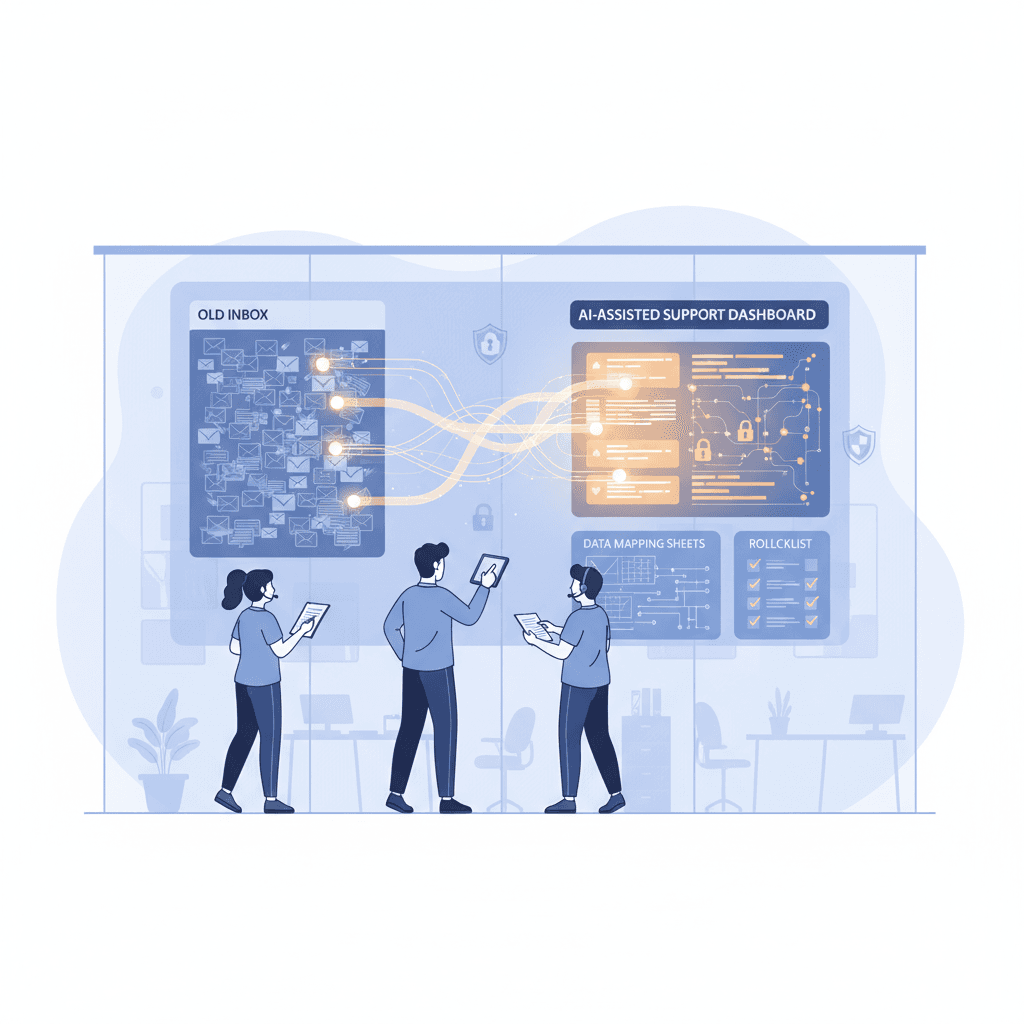
AI customer support adds governance questions to a familiar helpdesk decision. A ticketing platform may store conversations, attachments, customer details, and internal knowledge. An AI support agent may also send prompts and retrieved content to a model provider, create embeddings or indexes, and generate outputs that need review. The practical goal is to map those data flows and decide whether the available controls meet your risk requirements.
What is different about an AI helpdesk security review?
Traditional helpdesk due diligence focuses on user access, encryption, uptime, and data protection. Those still matter. AI introduces further questions: what content is sent to a model, whether that content is retained, whether it can be used to improve models, and where AI-related copies are stored.
Review the complete path for a typical customer request. A customer may submit a message containing personal data. The helpdesk stores it, an AI system may retrieve relevant knowledge, a model provider may process a prompt, and the resulting response may be saved in conversation history or logs. Each step can involve a different retention rule, access model, or third party.
Ask vendors to explain this flow in writing. A data-flow diagram is often more useful than a general statement that a service is secure or privacy-focused.
What should we ask about AI training and model processing?
Start with the question most teams need answered clearly: Is our customer content, knowledge base content, prompts, or AI output used to train or improve any model?
Ask separately about the helpdesk provider and every underlying model provider. “We do not train models” can be incomplete if a third party processes prompts under different terms. Request answers for conversations, uploaded files, attachments, retrieved knowledge, embeddings, prompts, outputs, and diagnostic logs.
- Which model providers process data for the AI support agent?
- Can the vendor identify every subprocessor involved in AI processing?
- Are prompts, outputs, or uploaded content retained by those providers?
- Is customer data used for model training, evaluation, or service improvement?
- Is a no-training or zero-retention arrangement available, and does it apply to your plan?
- Can AI access be restricted to approved knowledge sources?
- Can administrators review, correct, or remove knowledge that informs AI responses?
Do not assume that a commercial AI API, a vendor statement, or a plan label answers all of these questions. Ask for the terms that apply to your proposed configuration.
Where is support data stored, processed, and backed up?
Data residency is more than the location of the primary application database. Ask where production data, backups, logs, analytics data, model-processing systems, and AI knowledge indexes are stored or processed.
This matters when your organization has contractual, regulatory, or customer requirements for a specific region. It also helps you understand international transfers and the parties that receive data.
Request confirmation of:
- Available hosting and processing regions
- Where backups and disaster-recovery copies reside
- Whether region selection applies to AI prompts and AI indexes
- International transfer mechanisms, where relevant
- The roles of your business and the vendor in each data flow
A deployment choice can affect this analysis. Chatwoot is commonly considered by teams that want to explore self-hosted deployment, which can provide greater infrastructure control but also shifts responsibility for security hardening, patches, monitoring, backups, access controls, and compliance to the customer. Hosted services should be assessed under their own current terms and controls.
How should we assess access controls and auditability?
Support platforms contain customer conversations and often internal operational information. Your review should establish who can access that information, how access is limited, and whether important actions can be traced.
Ask whether the proposed plan supports role-based access controls, multi-factor authentication, single sign-on, user provisioning or deprovisioning, IP restrictions, and audit logs. The important detail is not merely whether a control exists, but whether it is available for the users, environments, and plan you intend to purchase.
Ask to see how an administrator would review access changes, exports, deletion actions, and configuration changes. For AI workflows, also ask who can change knowledge sources, prompts, or automation rules. Those settings can materially affect what an AI support agent sees and says.
What retention, deletion, and exit questions matter most?
Deletion should be evaluated as a process, not a button. A business may need to delete an individual conversation, honor a customer request, export all records, or remove data when a contract ends. AI systems can add copies outside the primary ticket record, including embeddings, retrieval indexes, logs, and backups.
Ask for default retention periods and whether your team can configure them. Then ask how deletion affects every relevant store, how long backup copies persist, and whether the vendor can provide confirmation. A strong exit review also covers exports of conversations, attachments, knowledge content, configuration, and relevant metadata.
Useful questions include:
- Can we export our support data in a usable format?
- Can we delete individual records and all account data?
- What happens to AI embeddings, prompts, outputs, and logs after deletion?
- How long can deleted data remain in backups?
- What data is retained after termination?
How do Chatspace, Chatwoot, Chatbase, and Crisp fit into a security comparison?
Use a consistent evidence request for every vendor rather than relying on high-level comparisons. Public documentation can change, vary by plan, and omit the exact AI data flows your team needs to understand.
For Chatspace, treat hosting location, subprocessors, model data use, retention, certifications, access controls, and compliance commitments as items to verify directly in current documentation and contract materials. Request a security questionnaire, data processing agreement, subprocessor list, and an explanation of the AI data path before approval.
For Chatwoot, distinguish carefully between self-hosted and managed deployments. Self-hosting may offer infrastructure and data-location control, while making your organization responsible for operating the environment securely. Review any managed option separately.
For Chatbase and Crisp, ask the same AI-specific questions: which providers receive data, what retention applies to uploaded content and conversations, whether data can be used for training, and which controls are included in the relevant plan and region. Published privacy or GDPR materials are useful starting points, not substitutes for written confirmation.
What documents should our team request before approval?
Create a small evidence packet that procurement, security, legal, and support leadership can review together. At minimum, request a current security overview, privacy notice, data processing agreement, subprocessor list, AI data-flow diagram, retention and deletion policy, incident-response commitments, and details on access controls.
If your requirements are higher risk, ask for relevant assurance materials under appropriate confidentiality terms and request a live demonstration of export, deletion, administrator access, and audit logging. Ensure the written response covers the exact service tier and deployment you will use.
What is the practical decision rule?
Choose an AI helpdesk only after the vendor can explain your data path, contractual protections, operational controls, and exit process in terms your team can verify. If an answer is vague, applies only to a different plan, or excludes AI-related stores such as prompts and embeddings, record it as an unresolved risk rather than assuming it is covered.
Good AI customer support depends on trustworthy information handling. A disciplined review helps your team use AI support agents with a clear understanding of where customer data travels, who processes it, and how your organization remains in control.
FAQ
Is a privacy policy enough to approve AI helpdesk software?
No. A privacy policy is a starting point. Request plan-specific details on subprocessors, AI processing, retention, deletion, access controls, and contractual terms such as a data processing agreement.
What data should be included in an AI retention review?
Review conversations, attachments, customer records, knowledge base content, prompts, outputs, logs, embeddings, vector indexes, analytics data, and backups.
Does self-hosting eliminate AI data-governance risk?
No. Self-hosting can change where application data resides, but your team still needs to assess chosen model providers, direct API calls, infrastructure security, access controls, backups, and operational responsibilities.
What is the first question to ask an AI helpdesk vendor?
Ask for a written data-flow diagram showing where customer messages, knowledge content, prompts, outputs, logs, and backups travel and which parties process each type of data.